Explore Mingkun experience for the airflow and pressure required for dilute-phase pneumatic conveying 探索明坤在稀相气力输送所需风量与压力方面的经验 Entdecken Sie Mingkuns Erfahrung zu Luftstrom und Druck für die pneumatische Dünnstromförderung
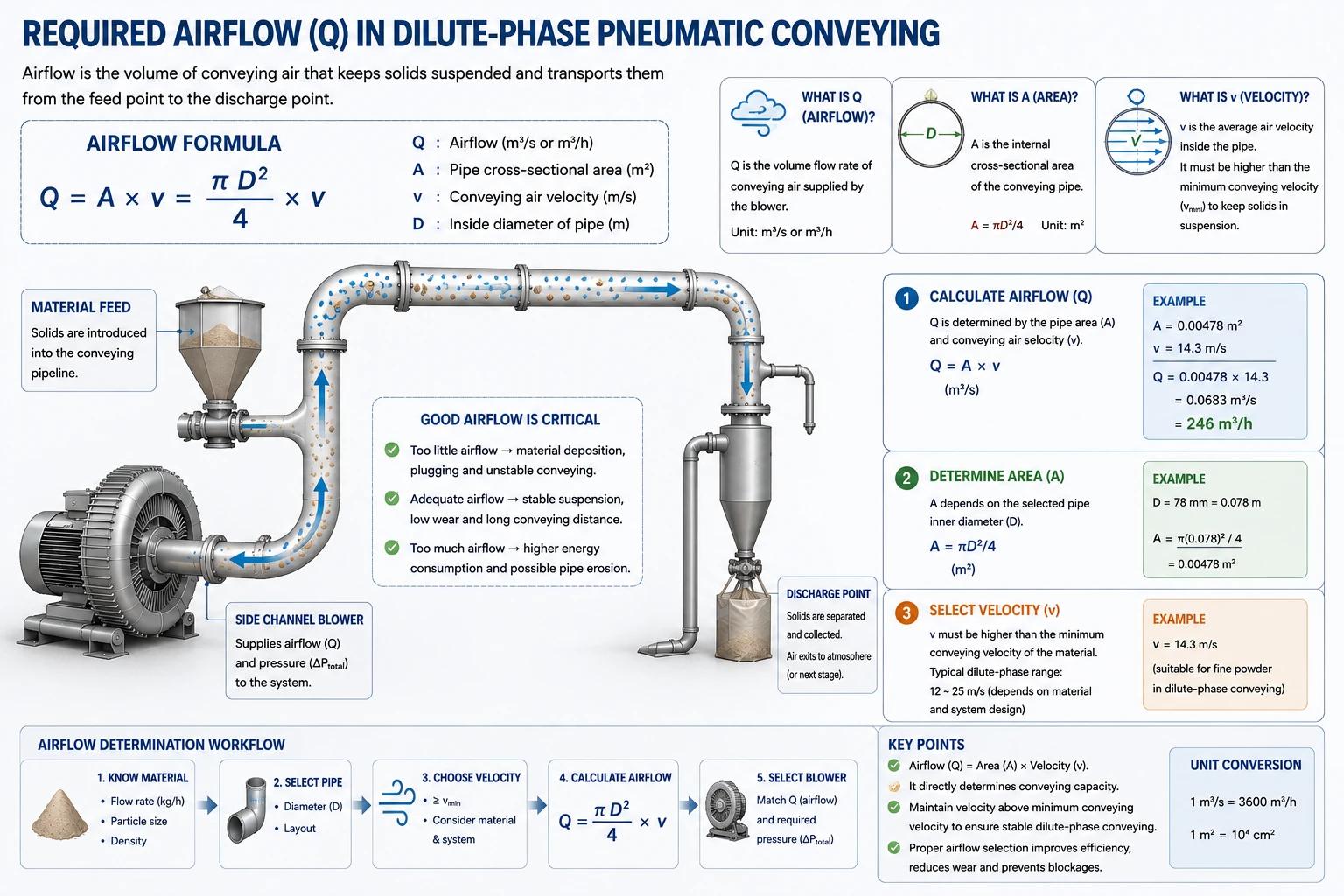
Dilute-phase pneumatic conveying transports powders, granules and other bulk solids through pipelines by maintaining sufficient conveying air velocity. Blower selection is therefore centered on two linked requirements: airflow and pressure. 稀相气力输送通过保持足够的输送气流速度,在管道中输送粉体、颗粒及其他散装固体。因此风机选型围绕两个相互关联的需求:风量与压力。 Die pneumatische Dünnstromförderung transportiert Pulver, Granulate und andere Schüttgüter durch Rohrleitungen, indem eine ausreichende Förderluftgeschwindigkeit aufrechterhalten wird. Die Gebläseauswahl dreht sich daher um zwei gekoppelte Anforderungen: Luftstrom und Druck.
Q = A × v = (πD² / 4) × v
The airflow requirement is determined by the conveying pipe area and the selected conveying air velocity. For a circular pipe, a larger diameter requires more airflow at the same velocity. 风量需求由输送管道面积和所选输送气流速度决定。对圆管而言,相同速度下管径越大所需风量越多。 Der Luftbedarf ergibt sich aus der Förderrohrfläche und der gewählten Förderluftgeschwindigkeit. Bei einem Kreisrohr erfordert ein größerer Durchmesser bei gleicher Geschwindigkeit mehr Luftstrom.
Volumetric airflow through the conveying line. Usually expressed as m³/h. Make sure the stated flow condition (free-air or actual line condition) is clearly defined. 通过输送管线的体积风量,通常以 m³/h 表示。应明确标注所注风量状态(自由空气或实际管内状态)。 Volumetrischer Luftstrom durch die Förderleitung, üblicherweise in m³/h. Der angegebene Strömungszustand (freie Luft oder tatsächlicher Leitungszustand) sollte klar definiert sein.
Internal flow area of the conveying pipe. For a round pipe: A = πD²/4, where D is the internal diameter in metres. 输送管道的内流通面积。圆管:A = πD²/4,D 为内径(米)。 Innenquerschnittsfläche des Förderrohrs. Bei einem Kreisrohr: A = πD²/4, wobei D der Innendurchmesser in Metern ist.
Average superficial air velocity in the conveying line. It is selected according to particle size, density, shape and the required conveying regime. 输送管线中的平均表观气流速度。根据颗粒尺寸、密度、形状及所需输送工况选取。 Mittlere Leerlauf-Luftgeschwindigkeit in der Förderleitung. Sie wird nach Partikelgröße, Dichte, Form und dem erforderlichen Förderregime gewählt.
Integrated diagram of pneumatic conveying airflow formulars 气力输送风量公式综合示意图 Integriertes Diagramm der Luftstromformeln für die pneumatische Förderung
Typical design example: 典型设计示例: Typisches Auslegungsbeispiel: 50 mm pipe at 22 m/s 50 mm 管道 @ 22 m/s 50-mm-Rohr bei 22 m/s
A = π × 0.05² / 4 = 0.001963 m² A = π × 0.05² / 4 = 0.001963 m² A = π × 0,05² / 4 = 0,001963 m²
Q = 0.001963 × 22 = 0.0432 m³/s Q = 0.001963 × 22 = 0.0432 m³/s Q = 0,001963 × 22 = 0,0432 m³/s
Required airflow ≈ 155 m³/h 所需风量 ≈ 155 m³/h Erforderlicher Luftstrom ≈ 155 m³/h
Design note: 设计说明: Designhinweis: Conveying velocity is not a universal fixed value. Published pneumatic-conveying guidance commonly uses different starting velocities according to the material and conveying regime; the final value should be checked against material behaviour and conveying stability. 输送速度并非通用固定值。公开的气力输送指南通常根据物料和输送工况采用不同的起始速度;最终取值应结合物料特性和输送稳定性校核。 Die Fördergeschwindigkeit ist kein allgemein fester Wert. Veröffentlichte Richtlinien zur pneumatischen Förderung verwenden je nach Material und Förderregime unterschiedliche Startgeschwindigkeiten; der endgültige Wert sollte anhand des Materialverhaltens und der Förderstabilität geprüft werden.
ΔPtotal =
ΔPair +
ΔPsolid +
ΔPacceleration +
ΔPlocal +
ΔPelevation +
ΔPequipment
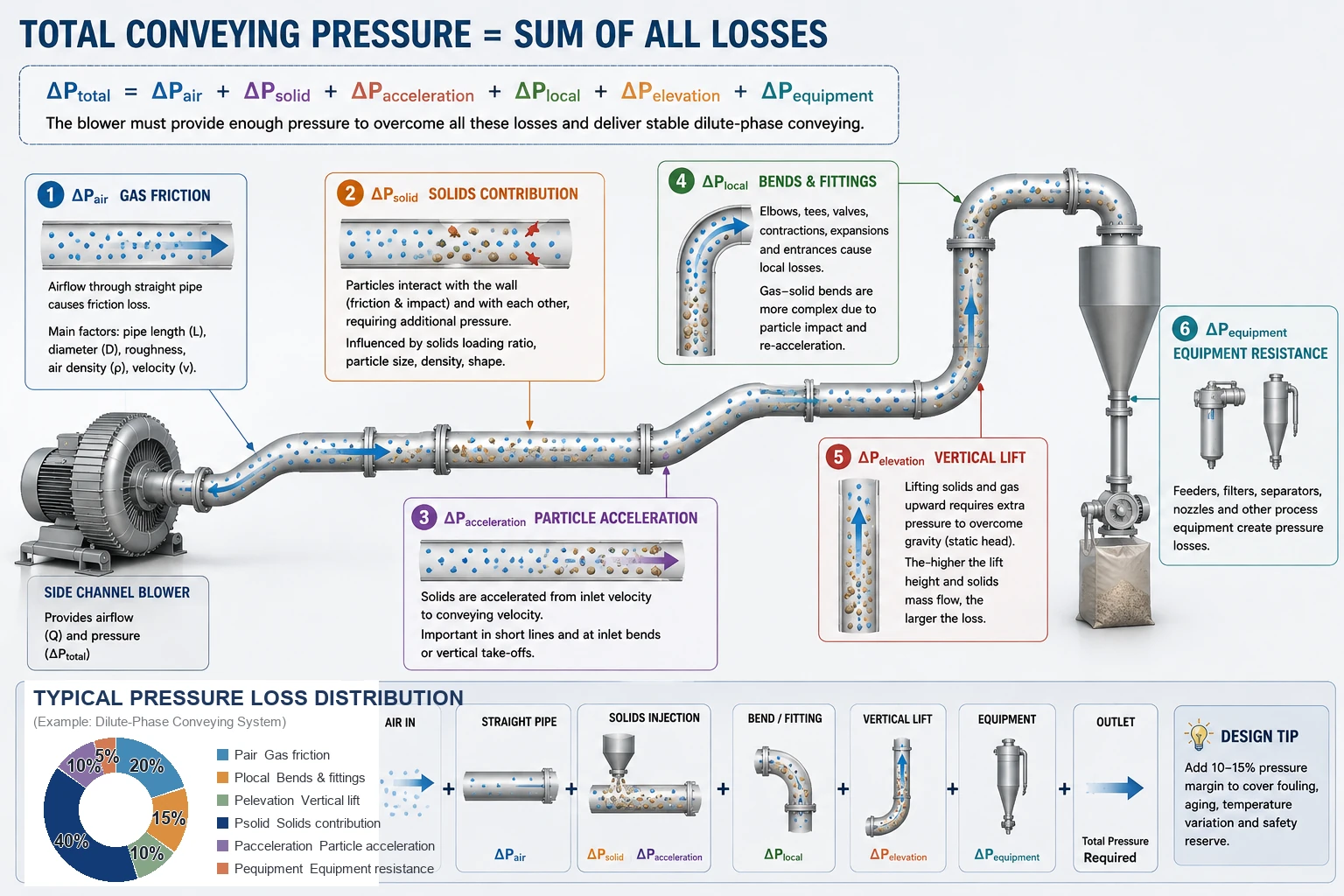
Total pressure is the pressure difference required to overcome gas friction, solids-related losses, particle acceleration, bends and other local resistances, elevation and equipment losses. The exact contribution of each term depends strongly on the conveying system and material. 总压力是克服气体摩擦、固体相关损失、颗粒加速、弯头及其他局部阻力、垂直提升和设备损失所需的压差。各项的具体占比强烈取决于输送系统和物料。 Der Gesamtdruck ist die Druckdifferenz zur Überwindung von Gasreibung, feststoffbedingten Verlusten, Partikelbeschleunigung, Bögen und anderen lokalen Widerständen, Höhen- und Anlagenverlusten. Der genaue Anteil jedes Terms hängt stark vom Fördersystem und Material ab.
Pressure loss caused by airflow through the straight pipe. A basic single-phase estimate uses Darcy-Weisbach: ΔP = f(L/D)(ρv²/2). 气流通过直管段引起的压力损失。单相估算用 Darcy-Weisbach 公式:ΔP = f(L/D)(ρv²/2)。 Druckverlust durch den Luftstrom im geraden Rohr. Eine einfache Einphasen-Abschätzung verwendet Darcy-Weisbach: ΔP = f(L/D)(ρv²/2).
Additional pressure required to transport the particles. It depends on solids loading, particle size, density, shape and particle-wall interaction. 输送颗粒所需的附加压力,取决于固体载荷、颗粒尺寸、密度、形状及颗粒-管壁相互作用。 Zusätzlicher Druck für den Transport der Partikel. Er hängt von der Feststoffbeladung, Partikelgröße, Dichte, Form und Partikel-Wand-Wechselwirkung ab.
Pressure associated with accelerating solids from their inlet velocity toward the conveying velocity. It can be important in short lines and systems with strong inlet acceleration. 将固体从入口速度加速至输送速度所需的压力。在短管线和入口加速强烈的系统中可能很重要。 Druck für die Beschleunigung der Feststoffe von der Eintrittsgeschwindigkeit auf die Fördergeschwindigkeit. In kurzen Leitungen und Systemen mit starker Eintrittsbeschleunigung kann er bedeutend sein.
Losses caused by elbows, tees, valves, contractions, expansions and entrances. Gas-solid bends are more complex than ordinary air-pipe fittings because particles change direction and may require re-acceleration. 由弯头、三通、阀门、收缩、扩张和入口引起的损失。气固两相弯头比普通空气管件更复杂,因为颗粒改变方向并可能需要重新加速。 Verluste durch Bögen, T-Stücke, Ventile, Verengungen, Erweiterungen und Einläufe. Gas-Feststoff-Bögen sind komplexer als normale Luftrohrformstücke, da Partikel ihre Richtung ändern und erneut beschleunigt werden müssen.
Additional pressure required when solids and gas are conveyed upward. Vertical sections add static-head effects, especially when the solid mass flow is significant. 固体与气体向上输送时所需的附加压力。垂直段增加静压头效应,尤其当固体质量流量较大时。 Zusätzlicher Druck bei der Förderung von Feststoffen und Gas nach oben. Vertikale Abschnitte erzeugen statische Höheneffekte, insbesondere bei erheblichem Feststoff-Massenstrom.
Pressure losses from feeders, filters, separators, nozzles and other process equipment installed in the conveying system. 输送系统中给料机、过滤器、分离器、喷嘴及其他工艺设备造成的压力损失。 Druckverluste durch Zuführer, Filter, Abscheider, Düsen und andere Prozessgeräte im Fördersystem.
Integrated diagram of pneumatic conveying pressure formulars parameters 气力输送压力公式参数综合示意图 Integriertes Diagramm der Druckformelparameter für die pneumatische Förderung
Illustrative working conditions: 示例工作条件: Beispielhafte Arbeitsbedingungen: 800 kg/h fine powder, 80 μm average particle size, 2500 kg/m³ particle density, 78 mm conveying pipe, 15 m horizontal line, 30 m vertical lift, and 8 × 90° bends. 800 kg/h 细粉,平均粒径 80 μm,颗粒密度 2500 kg/m³,输送管 78 mm,水平段 15 m,垂直提升 30 m,8 个 90° 弯头。 800 kg/h Feinpulver, mittlere Partikelgröße 80 μm, Partikeldichte 2500 kg/m³, Förderrohr 78 mm, horizontale Leitung 15 m, vertikale Förderhöhe 30 m und 8 × 90°-Bögen.
1. Airflow calculation 1. 风量计算 1. Luftstromberechnung
Pipe area = π × 0.078² / 4 ≈ 0.00478 m² 管道面积 = π × 0.078² / 4 ≈ 0.00478 m² Rohrquerschnitt = π × 0,078² / 4 ≈ 0,00478 m²
Using a conveying velocity of about 14.3 m/s: 采用约 14.3 m/s 的输送速度: Bei einer Fördergeschwindigkeit von etwa 14,3 m/s:
Q = 0.00478 × 14.3 ≈ 0.0683 m³/s Q = 0.00478 × 14.3 ≈ 0.0683 m³/s Q = 0,00478 × 14,3 ≈ 0,0683 m³/s
Required airflow ≈ 246 m³/h 所需风量 ≈ 246 m³/h Erforderlicher Luftstrom ≈ 246 m³/h
2. Pressure requirement 2. 压力需求 2. Druckbedarf
For the published 78 mm dilute-phase conveying case, the calculated total pressure requirement is approximately 17.8 kPa. The value is obtained by calculating the applicable pressure-loss terms for the 15 m horizontal line, 30 m vertical lift and 8 × 90° bends, then summing them. 针对公开的 78 mm 稀相输送案例,计算得到的总压力需求约 17.8 kPa。该值通过对 15 m 水平段、30 m 垂直提升和 8 个 90° 弯头计算相应压力损失项后求和得出。 Für den veröffentlichten 78-mm-Dünnstromfall beträgt der berechnete Gesamtdruckbedarf etwa 17,8 kPa. Der Wert ergibt sich aus der Berechnung der zutreffenden Druckverlustterme für die 15 m horizontale Leitung, 30 m vertikale Förderhöhe und 8 × 90°-Bögen und deren Summierung.
The pressure requirement is calculated using the same system-pressure framework introduced above: 压力需求采用上文介绍的系统压力框架计算: Der Druckbedarf wird mit dem oben eingeführten Systemdruck-Rahmenwerk berechnet:
ΔPtotal = ΔPair + ΔPsolid + ΔPacceleration + ΔPlocal + ΔPelevation + ΔPequipment
| Pressure-loss term 压力损失项 Druckverlustterm | Calculation used in this example 本例采用的计算 In diesem Beispiel verwendete Berechnung | Result 结果 Ergebnis |
|---|---|---|
| ΔPair | Gas-wall friction along the 15 m horizontal + 30 m vertical pipe sections. 15 m 水平 + 30 m 垂直管道段的气壁摩擦。 Gas-Wand-Reibung entlang der 15 m horizontalen + 30 m vertikalen Rohrabschnitte. | ≈ 1.366 kPa |
| ΔPsolid | Solid-wall friction for the conveyed particles in the horizontal + vertical sections, using the gas-solid conveying correlation for the published case. 水平 + 垂直段中输送颗粒的固壁摩擦,采用该公开案例的气固输送关联式。 Feststoff-Wand-Reibung der geförderten Partikel in den horizontalen + vertikalen Abschnitten unter Verwendung der Gas-Feststoff-Förderkorrelation des veröffentlichten Falls. | ≈ 8.407 kPa |
| ΔPacceleration | Gas acceleration + particle acceleration at the solids inlet. Calculated acceleration contributions are approximately 0.123 kPa + 0.270 kPa. 固体入口处的气体加速 + 颗粒加速。计算得到的加速贡献约 0.123 kPa + 0.270 kPa。 Gasbeschleunigung + Partikelbeschleunigung am Feststoffeinlass. Die berechneten Beschleunigungsanteile betragen etwa 0,123 kPa + 0,270 kPa. | ≈ 0.393 kPa |
| ΔPlocal | 8 × 90° bends. The published conveying method treats each bend using the specified equivalent vertical-section relationship. 8 个 90° 弯头。该公开输送方法按指定的等效垂直段关系处理每个弯头。 8 × 90°-Bögen. Die veröffentlichte Fördermethode behandelt jeden Bogen über die angegebene Beziehung zum äquivalenten vertikalen Abschnitt. | ≈ 6.281 kPa |
| ΔPelevation | Solid static head + gas static head for the 30 m vertical lift, approximately 0.986 kPa + 0.353 kPa. 30 m 垂直提升的固体静压头 + 气体静压头,约 0.986 kPa + 0.353 kPa。 Statischer Feststoffdruck + statischer Gasdruck für die 30 m vertikale Förderhöhe, etwa 0,986 kPa + 0,353 kPa. | ≈ 1.339 kPa |
| ΔPequipment | No feeder, filter, separator, nozzle or other equipment pressure drop is specified in this published pipe-system example. 该公开管道系统示例中未指定给料机、过滤器、分离器、喷嘴或其他设备压降。 In diesem veröffentlichten Rohrsystembeispiel ist kein Druckabfall für Zuführer, Filter, Abscheider, Düsen oder andere Geräte angegeben. | 0 kPa |
| ΔPtotal | 1.366 + 8.407 + 0.393 + 6.281 + 1.339 + 0 | ≈ 17.786 kPa |
Therefore, the calculated system pressure requirement for this example is approximately 17.8 kPa. This is a case-specific result; actual equipment resistance and material behaviour must be added or re-evaluated when the real conveying system differs from the published case. 因此本例计算的系统压力需求约 17.8 kPa。这是特定案例的结果;当实际输送系统与该公开案例不同时,必须补充或重新评估实际设备阻力和物料特性。 Der berechnete Systemdruckbedarf für dieses Beispiel beträgt daher etwa 17,8 kPa. Dies ist ein fallspezifisches Ergebnis; tatsächlicher Gerätewiderstand und Materialverhalten müssen ergänzt oder neu bewertet werden, wenn sich das reale Fördersystem vom veröffentlichten Fall unterscheidet.
3. Blower matching principle 3. 风机匹配原则 3. Gebläseauswahlprinzip
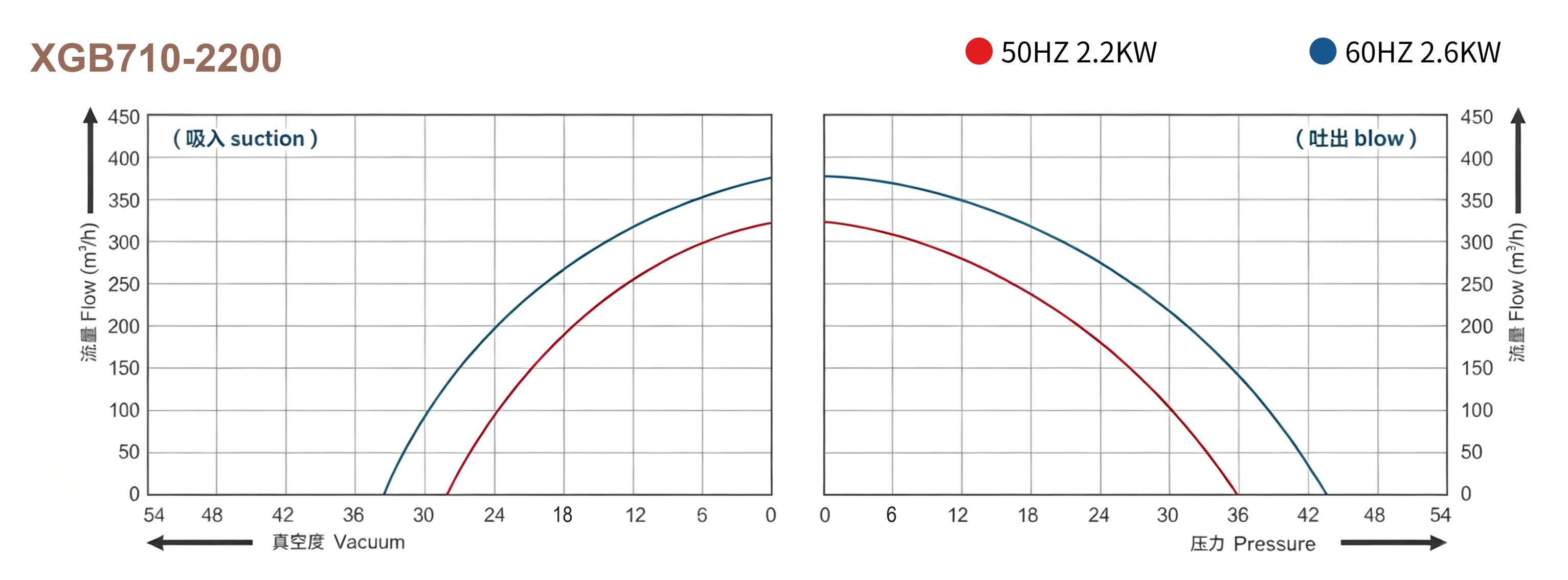
The required operating point for preliminary blower matching is approximately: 246 m³/h @ 17.8 kPa. 初步风机匹配所需工作点约为:246 m³/h @ 17.8 kPa。 Der erforderliche Arbeitspunkt für die vorläufige Gebläseauswahl beträgt etwa: 246 m³/h @ 17,8 kPa.
Blower P-Q performance curve with the required pneumatic conveying operating point 风机 P-Q 性能曲线与所需气力输送工作点 Gebläse-P-Q-Leistungskurve mit dem erforderlichen Förderarbeitspunkt
Important: 重要提示: Wichtig: blower selection must be checked against the actual P-Q performance curve. Maximum airflow and maximum pressure are separate end points and must not be treated as a simultaneous operating point. 风机选型必须对照实际 P-Q 性能曲线校核。最大风量与最大压力是两个独立端点,不能视为同时成立的工作点。 Die Gebläseauswahl muss anhand der tatsächlichen P-Q-Leistungskurve geprüft werden. Maximaler Luftstrom und maximaler Druck sind getrennte Endpunkte und dürfen nicht als gleichzeitiger Arbeitspunkt behandelt werden.
| Indicative Operating Point 典型工作点 Beispielhafter Arbeitspunkt | Pressure 压力 Druck | Airflow 风量 Luftstrom | Initial HT Reference 初始 HT 参考 Erste HT-Referenz |
|---|---|---|---|
| Light / short conveying line 轻型 / 短输送管线 Leichte / kurze Förderleitung | 10 ~ 15 kPa | 40 ~ 100 m³/h | XGB-310 / XGB-510 |
| Medium dilute-phase conveying 中等稀相输送 Mittlere Dünnstromförderung | 15 ~ 20 kPa | 100 ~ 160 m³/h | XGB-510 / XGB-610 |
| Higher-flow, moderate-pressure conveying 大流量、中压输送 Höherer Luftstrom, mittlerer Druck | 15 ~ 20 kPa | 200 ~ 250 m³/h | XGB-610 / XGB-710 |
| High-resistance conveying line 高阻力输送管线 Hochwiderstands-Förderleitung | 20 ~ 30 kPa | Application dependent 视应用而定 Anwendungsabhängig | XGB-710 / multi-stage or other solution多级或其他方案mehrstufig oder andere Lösung |
Selection note: 选型说明: Auswahlhinweis: These ranges are preliminary application references, not guaranteed operating points. Final model selection must use the actual blower P-Q curve at the required pressure and airflow, with allowance for system variation and operating conditions. 这些范围是初步应用参考,并非保证的工作点。最终型号选择必须使用所需压力与风量下的实际风机 P-Q 曲线,并为系统变化和运行条件留有余量。 Diese Bereiche sind vorläufige Anwendungsreferenzen, keine garantierten Arbeitspunkte. Die endgültige Modellwahl muss die tatsächliche P-Q-Kurve beim erforderlichen Druck und Luftstrom verwenden, mit Berücksichtigung von Systemabweichungen und Betriebsbedingungen.